Monday, January 4, 2010

XOCHICALCO


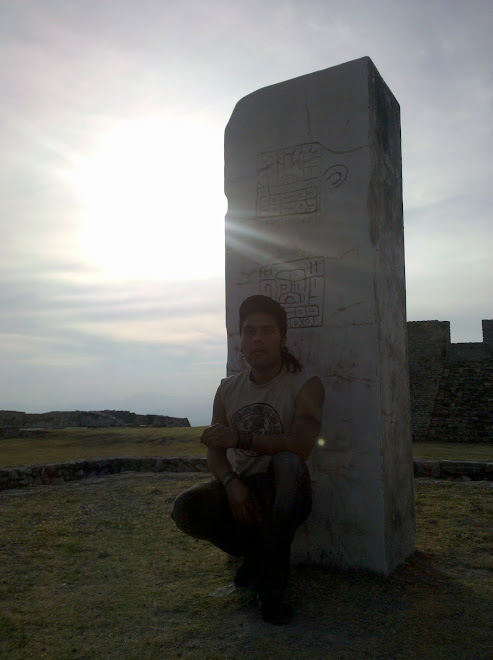
Xochicalco, which means "In the place of the House of the Flowers", lies atop an array of low-lying hills, the main ones of which are known as La Bodega, La Malinche, and Xochicalco. The site was laid out and built in accordance with a carefully contrived urbanization plan. The summit of Xochicalco hill was graded so as to facilitate the construction of the main buildings, and the slopes, too, were altered to provide room for homes and terraces to prevent easy access to the site. Xochicalco reached its height as one of the great cities of Meso-America in Late Classic times (AD 650-900). Most of the monumental architecture now visible was constructed during that period. I think this could be considered one of the most beautiful cities in the world at the time it was constructed. It is a very well thought out design of terraces, streets, plazas and buildings. And located on the top of the mountain there is a fantastic view in every direction.

The rise and development of Xochicalco is best understood in its relation to Teotihuacan, the dominant urban center in Meso-America throughout the Classic Period. According to some researchers, Xochicalco must have risen following the abandonment of that center of the central plateau in order to fill in the economic and political power vacuum created by the decline.
The distribution of Xochicalco followed a hierarchical order; on the peak, surrounded by barriers, is the Acropolis, a residential area for the leaders and their families. At the Main Plaza is the Pyramid of the Feathered Snakes and other buildings, where the political, economic and religious goals of the city were decided. On a lower terrace is the Great Pyramid, where religious ceremonies took place.
One of the most outstanding constructions of Xochicalco, is the the temple of Quetzalcoatl, widely recognized by his refined high - relieves wich represent different symbols and passages from this God, symbolized by the effigy of the feathered snake.
The Pyramid of the Feathered Snakes has beautiful sculpted relieves, representing eight huge feathered snakes embellished with great headpieces, snails, important leaders and the new fire symbol. On the panel there is a series of persons holding a bag that represents the symbol for speech and a disc divided into four, possibly representing a solar eclipse, phenomenon visible from Xochicalco in 743 A.D.
In 1963 remains were found of two substructures built previously to those visible today, as well as of ferings and burials. The main motif depicts Quetzalcoatl as the plumed serpent. It is to be noted that the wooden beams of the stairway look like the ventral scales of a snake's body. The rest of the decorative elements are related to personages, cylindrical signs, and places. On the upper part there are, between the undulations of the serpent, several human figures, some with the slash denoting the spoken word. The may represent priests or great chieftains. In combination with these dignitaries can be seen the sign for fire together with a date (symbolized by one bar and four dots). On the sides, above this first body, there are reproductions of priests with their calendar names. On the upper part of the structure are found human figures identifiable as warriors because some wear helmets and feathered headdress and hold atlatl, that is, lance throwers. These figures are shown with place symbols and their names. On the left of the staircase there is a remarkable carving which shows sign 5 calli, "house", being joined with sign 11 ozomatli, "monkey", by a personage standing behind and pulling "monkey" with a rope. This has been interpreted as a calendar correction or adjustment. Thus the most common idea as to the function of the structure is that it commemorates a meeting of priests and great chieftains for the adjustment of the Meso-American calendar, although the monument may have other meanings..
Archaeologists state there was an astronomer recording the sunrise every day, for many generations, in order to observe the sun’s dynamic, thus establishing climate patterns according to the stars. It was the venue for a gathering of priests from all Mesoamerican cultures that made an adjustment to the calendar. This event was recorded on the Pyramid of Quetzalcoatl.

The plaza faces the sunset, marking equinoxes and solstices because the inhabitants of Xochicalco depended on agriculture. This issue led them to develop a very precise system for establishing the cycles of the sun, moon, planets and stars in a ritual revolving around the agricultural calendar. Every March 21 at sunrise, the sun shines exactly through the middle of a sculpture, aligning with an inscription and the central monument.
Estructura A. Around a court yard at its top there are two halls and the Temple of the Steles, so called because of three steles found in a stone encasement beneath the flooring. These steles are now on display at the National Museum of Anthropology. They are carved in low relief and exhibit remains of red or vermilion paint. They narrate various events related to Quetzalcoatl such as the Venusian cycle, wherein Venus is transformed into Quetzalcoatl, who represents this god as the lord of time with respect to his invention of the calendar, as well as to his creation of the Fifth Sun in Teotihuacan and his discovery of maize (corn).
The Chamber of Offerings. This is a small building next to Structure A. It contains a single room or chamber in which an offering consisting of two smooth stone yokes related to the cultures of central Veracruz were found together with and anthropomorthic ax and a stone tablet with the hieroglyphs 5 or 10 acatl and 4 tochtli. These findings, as well as the Mayan and Zapotec glyphs uncovered in the Pyramid of the Plumed Serpent, have been interpreted as evidence of close contacts between Xochicalco and distant areas. Ball Court. This is one of the two buildings of this type excavated in the zone (the other, less elaborated, is located on the north side of the Ceremonial Plaza). Because of the size, shape, layout, and other features, it has been compared with several others in Mayan area

The cave is an astronomical observatory, used to recognize the beginning of the agricultural cycle. Originally, it was covered in stucco painted in black, yellow and red. Its observation chimney precisely projects sunlight and during the night, it allows a perfect view of the stars. Two of the many natural underground caves at Xochicalco, show clear evidence of architectural modification, including the perforation of an artificial hole or "chimney" from the cave to the ground above. These vertical shafts would have enabled very precise observations and measurements of solar and possibly planetary events. For instance, the vertical north side of the 5-meter-long "chimney" down into one cave would have resulted in a precisely vertical beam of sunlight on the day of the zenith. The south side of the chimney slopes at an angle of 4o23'. Is it simply a coincidence that this is the exact angle for light to be parallel to this side on June 21, the day of the Summer solstice? Archeo-astronomers think not!

The dimensions and geometry of this chimney ensure that some light enters the cave every day from April 30 (15 days before the first of the two annual zeniths) to August 12 (15 days after the second). Put another way, the cave receives light every day from precisely 52 days before the solstice to 52 days after it. The number 52 was of immense significance in the pre-Columbian calendar, since it took exactly 52 (solar) years for both the solar calendar and the ritual calendar (of 260 days each) to return simultaneously to the equivalent of 0-0.

Another fascinating finding, first published in México Desconocido, is that from the "Acropolis" of the site, on zenith days, the sun rises exactly behind Popocatépetl volcano on the eastern horizon. The effect does not occur even one day before or after the zenith. Given the polluted skies over Mexico City, it is difficult to guarantee witnessing this effect nowadays!

The site of Xochicalco is living proof of one of the most important scientific summits ever held in the history of the Americas. The congress of astronomers from all over the zone held to agree the calendric correction was a landmark event in the history of science worldwide.

Xochicalco is a fascinating place to wander around. Let your imagination wander. Imagine the astronomers and their cohorts engaged in deep philosophical discussions.

Sunday, January 3, 2010

“XOCOLATL AZTECA”


The Feathered Serpent Quetzalcoatl, of the Aztecs, was one of the first deities of peace. Within Quetzalcoatl’s mythology is the myth that he flew the sacred cacao tree from paradise to give to the humans. Not only was Quetzalcoatl a peaceful god, he was also the god of wisdom and power. The Aztecs believed that chocolate was a food imbued with the knowledge of Quetzalcoatl. Archaeologists have found evidence that the Mayans used cacao in celebrations. It is thought that as early as 1,500 B.C. these early people had discovered the health benefits of chocolate.the word comes from Nahuatl, "xocolatl" (pronounced [ ʃoˈkolaːtɬ]) made up from the words "xococ" meaning sour or bitter,[2] and "atl" meaning water or drink

Back then it was a bitter beverage revered for its nourishing qualities and ability to boost energy and stamina; treat stomach and intestinal complaints and infections, fever and coughs.

They mixed it with fermented and roasted cocoa paste, water, chilli peppers, cornmeal and other ingredients - blended into a spicy, frothy and sugar-free drink. It was regarded as a ‘divine drink’Drinking chocolate was an important part of Maya and Aztec life.
Many people in Classic Period Maya society could drink chocolate at least on occasion, although it was a particularly favored beverage for royalty. But in Aztec society, primarily rulers, priests, decorated soldiers, and honored merchants could partake of this sacred brew.

Chocolate also played a special role in both Maya and Aztec royal and religious events. Priests presented cacao seeds as offerings to the gods and served chocolate drinks during sacred ceremonies.The cacao tree was looked upon by the Aztecs as a gift from their peaceful god Quetzalcoatl (“feathered serpent”). The Aztecs would ingest cacao together with Psilocybe (enthogenic mushrooms), in religious rituals, a practice still conducted today by numerous tribes throughout the region. The Yucatec Maya venerate a black god named Ek Chuah as their cacao deity and local cacao farmers hold a festival in the god’s honor during the month of Muan in the old Mayan calendar.

Cacao’s psychoactive material manifest in the cacao beans, the cocoa shells, in the cocoa butter and in the fresh fruit pulp. Inebriating effects described by Aztec sources may likely be due to the cacao additives, or to a synergism with added substances such as psilocybe mushrooms. Folk lore has described the traditionally prepared Indian drink to be very stimulating and euphoric. These effects, however, cannot be expected from modern day’s commercially produced cocoa.

An Aztec text from the early colonial period provides a precise description of the tree and of the drink, which it noted to be inebriating. The Aztecs described the cacao tree as being simply round in shape with broad branches. They portray the tree’s fruits to appear much like dried ears of maize, thus they often referred to the fruit as “cacao ears.” Ranging in color from reddish brown to whitish brown to bluish brown, the heart of the fruit looks much like an ear of corn.

When the ceremonial drink made from cacao is imbibed in moderation, especially from those ears which are green and tender, one benefits by feeling happy, refreshed, comforted and stronger than before. The Cacao Tree was worshipped by the Mayan civilisation of Central America and Southern Mexico, who believed it to be of divine origin, Cacao is actually a Mayan word meaning "God Food" hence the tree's modern generic Latin name 'Theobrama Cacao' meaning ‘Food of the Gods’. Cacao was corrupted into the more familiar 'Cocoa' by the early European explorers. The Maya brewed a spicy, bitter sweet drink by roasting and pounding the seeds of the Cacao tree (cocoa beans) with maize and Capsicum (Chilli) peppers and letting the mixture ferment. This drink was reserved for use in ceremonies as well as for drinking by the wealthy and religious elite, they also ate a Cacao porridge.

The Aztecs of central Mexico also prized the beans, but because the Aztec's lived further north in more arid regions at higher altitudes, where the climate was not suitable for cultivation of the tree, they had to acquire the beans through trade and/or the spoils of war. The Aztecs prized the beans so highly they used them as currency - 100 beans bought a Turkey or a slave - and tribute or Taxes were paid in cocoa beans to Aztec emperors. The Aztecs, like the Mayans, also enjoyed Cacao as a beverage fermented from the raw beans, which again featured prominently in ritual and as a luxury available only to the very wealthy. The Aztecs called this drink Xocolatl, the Spanish conquistadors found this almost impossible to pronounce and so corrupted it to the easier 'Chocolat', the English further changed this to Chocolate.

The Aztec's regarded chocolate as an aphrodisiac and their Emperor, Montezuma reputedly drank it fifty times a day from a golden goblet and is quoted as saying of Xocolatl: "The divine drink, which builds up resistance and fights fatigue. A cup of this precious drink permits a man to walk for a whole day without food"

In fact, the Aztec's prized Xocolatl well above Gold and Silver so much so, that when Montezuma was defeated by Cortez in 1519 and the victorious 'conquistadors' searched his palace for the Aztec treasury expecting to find Gold & Silver, all they found were huge quantities of cocoa beans. The Aztec Treasury consisted, not of precious metals, but Cocoa Beans.

Monday, December 28, 2009

MALINALCO


malinalco was one of the most important architectural sites because of its asociation with aztec religious history and for its military nature.Malinalco is the place where the tree levesls of teh cosmos unite .. the sky the earth and the underworld . its well known for its shamnism and as the place where copil, nephew of hutzilopochtli and son of Malinalxochitl, fought huitzolopochtli , copil was defeated , and his heart was thrown over lake texcoco and landed on the island that would later become tenochtitlan.
TEMPLE CUAUHCALLI
The major estructure of malinalco is a temple called the cuauhcalli, meaning house of eagles. like mos aztec arquitecture the cuauhcalli represents in its contruction historical and religious beliefs like honor to tlaltecutli or coatlicue the earth godess trough is function of sanctuary tha represent the earth itself on which aztec warriors struggled in warfare and perished fighting offering their lives to the sun.but also can represent like the main temple of tenochtitlan. mt coatepec (snake mountain'.which is a transitional place on the surface of the earth (tlalticpac)connecting the middle world with the heavens and underworld is the mitycal house of coatlicue represent by the serpent mouth door.
This site is where new members were inducted into the Order of the Jaguar and Eagle.
At the entrance you find a couple of warriors seating over giant snake heads standing guard besides each side of the door, the interior if off-limits because the floor is still original, take a look and you will see a huge tongue of a snake rolled out like a red-carpet welcoming the warriors to the special ceremonies. Inside you will find benches and statues, all of them carved out of the rock of the hill, so there are no external pieces at all. Every single piece was hand carved, it was simply no margin for error, all the artisans should have been top notch and masters of their trade. This was a place were only kings, priests and warriors could enter.
it was bealived by warriors that the hearts placed in the circular hole of the shrines floor aided huitzilopochtli in his nightly quests , in the exterior next to the portal on the southeast side, there is a xiubcoatl, the weapon used by huitzilopochtliwhen he traveled from east to west , and also confirm that the dsay of the winter solstice december 21 at noon the light of the sun coming from a cleft in a mountain located in front ofn the temple enters through the doorway , iluminating exactly the head of the eagle that its the embodyment of huitzilopochtli, the sun himself , furthemore , we know through fray bernandino de sahagun that on this day the panquetzaliztli was celebarted , a festival dedicated to honor sacrifice because this was the day of the descent of huitzilopochtli to the earth , it means that the orientation of this temple was built with this solsticial effect in mind...

Sunday, December 27, 2009

TOLAN MEXIHCO TENOCHTITLAN


TLOQUE NAHUAQUE IN TLALTIPAC METZTLI CUALO TONAL MACHOTL
EL SOL Y LA LUNA SE AMARRAN EN EL OMBLIGO DEL UNIVERSO
en el centro del cosmos girando en sombras con reflejos de luz nacio en eclipse solar TOLAN MEXIHCO TENOCHTITLAN , fundacion portentosa que en vuelos de libertad se alzo la vida en cristal de roca y lajas de obsidiana , pedernales y cuentas de jade , Hombres culturas organicas de teotl , se apropiaron de su destino , lo hicieron suyo , como arquitectos lo planearon con peso, numero y medida, le dieron forma con sus manos ,ajustando su vida la devenir de la existencia sin riesgo alo desconocido implantaron codigos de justicia, apegados a leyes naturales con normas eticas para la convivencia colectiva cordinada al comportamiento social, perfectamente organizados con el orden bilogico del universo .
lejos muy lejos del tiempo ancestral y cercade nuestro espacio en ritmo danzaban por la vida los mexihcas (y seguimos danzando)quienes partieron un dia de la legendaria tierra de las 7 cuevas , CHIKOMOSTOK peregrinos de aztlan ivan en camino en busca de su destino , TEOPILTSINTLI YAOTL MEXIUITSILOPOCHTLI, potencia viviente que personifica la voluntad del guerrero solar , les transmitio el mensaje profetico de las estrellas , atraves dl supremo tlamatinime TENOCH ( el tunal sobre la piedra)verdadero maestro y guia espiritual, que condujo alos tenochkas hasta las fertiles tierras de anahuac en donde sus ojos se abrieron al magico encuentro del principio unico la busquedad eterna el el velo del misterio transpuso sus limites y la esencia sublime de ometeotl se dejo sentir en el corazon dela raza ATLANTEKA MEXIHCA, que atravez de sus emblemas nos transmiten ideas profundas y conocimientos universales , simbolismo d eun saber milenario que nos revela el misterio ancestral de un ritual sagrado de transformacion , muerte y resureccion trascendencia y permanencia de nuestro ser , uno en el origen y en al continuidad de nuestra presencia , esencia que se prolonga desde tiempo inmemorial, para la recordacion d ela historia de los antepasados , que atraves de la energia suprema del Atl Tlachinoll realizaron el PLUMAJE CELESTE DE FUEGO SERPENTINO,

Saturday, December 26, 2009

TULA


,Tula (or Tollan) was the capital of the Toltec empire and followed Teotihuacan as the strongest power in Mesoamerica.The Toltecs spoke Nahuatl, which was also spoken by the Aztecs. The city of Tula was located about 50 miles north of present-day Mexico City and contained impressive buildings,

The Toltec empire is believed to have been destroyed around 1200 AD by the nomadic warriors of the Chichimecs. The ruling family of the Aztecs claimed to descend from Toltec ancestry via the sacred city of Colhuacan. Most Toltec history is known from writings of later people, such as the Aztec, written centuries later after a "dark age" in Central Mexico, together with some references by the Maya. Toltec rulers are said to have included:

Chalchiuh Tlatonac - first Toltec king, founder of Tula
Mixcoamazatzin
Huetzin
Mixcoatl or Mixcoatl Totepeuh
Ihuitimal
Topiltzin Ce Acatl Quetzalcoatl, son of Mixcoatl, the most famous Toltec ruler
Matlacxochitzin
Nauhyotzin
Matlacoatzin
Tlilcoatzin died c. 1000 (?)Huemac the last Toltec king, died in exile c. 1100 (?), some 6 years after the fall of Tula The Toltec Empire and leaders created an unmatched mystique in the minds of the Central American people. The Toltec leaders were thought of as being alongside deities. Later cultures often revered them and copied their legends, art, buildings and religion. Many future rulers of other cultures, including Mayan leaders and Aztec emperors, claimed to be descended from the Toltecs. Religion in the Toltec Empire was dominated by two major deities. The first, Quetzalcoatl, is shown as a plumed serpent. This deity of learning, culture, philosophy, fertility, holiness and gentility was absorbed from earlier cultures in the area. His rival was Tezcatlipoca, the smoked mirror, known for his warlike nature and tyranny.

The greatest ruler of the Toltecs was Ce Acatl Topiltzin who was renown for being the leader and high priest of Quetzacoatl at the time when Tula and the Empire were established. According to Toltec legend, Tezatlipoca's followers drove Topiltzin and the followers of Quetzalcoatl out of the city around 1000 AD. They fled south, where they were able to defeat the Maya at the city of Chichen Itza, and take it for their own. An interesting twist in Topiltzin's legend is that he vowed to return to Tula from the east in one of his sacred years and take his vengeance. This legend lived all the way to the time of the Aztecs, who attributed the arrival of the Spanish as the return of Topiltzin, an event that they feared greatly. Black Feathered Sun
The history of the Toltec culture at Teotihuacan is shrouded in mystery. It is speculated that around the year 500 AD the Toltec Naguals and all their parties had learned how to transmute, to go through the Black Feathered Sun to the place of creation.


Toltec have been known throughout southern Mexico as "women and men of knowledge" for many centuries. Anthropologists have spoken of the Toltec as a nation or a race, but in fact, the Toltec were scientists and artists who formed a society to explore and conserve the spiritual knowledge and practices of the ancient ones. It may seem peculiar that they combined the secular with the sacred, but the Toltec considered science and spirit to be one and the same since all energy, whether material or ethereal, was derived from the one source and influenced by the same universal laws.

The Toltec came together as Toltec masters and students at Teotihuacan, the ancient city of pyramids outside Mexico City known as the place where "Man becomes God". Here, in order to realize the promise of the work to transcend the realm of ordinary human awareness and attain their personal freedom, the apprentices studied the three Toltec masteries: Awareness, Transformation (Tracking) and Intent. The students had to have the courage to face and know themselves and, through that knowing, change their way of life. Teotihuacan remained the Toltec center of spiritual knowledge and transformation for many thousands of years and still endures as a living repository of "silent knowledge".

teotihuacan


Teotihuacan means 'The City of the Gods", or "Where Men Become Gods"
(in Nahuatl). It is located in the valley of the same name 30 miles north of Mexico City.
Teotihuacan used to be a thriving city and ceremonial center that predated the Aztecs by several centuries. Most likely it was Mexico's biggest ancient city at its peak and the sixth largest city in the world in AD 600. Though archaeologists have long been fascinated with the site, Teotihuacan's culture and history are still largely mysterious. The civilization left massive ruins, but no trace has yet been found of a writing system and very little is known for sure about its inhabitants, who were succeeded first by the Toltecs and then by the Aztecs.
The Aztecs did not live in the city, but gave the place and its major structures their current names. They considered it the "Place of the Gods" - a place where, they believed, the current world was created.

the Sun Pyramid was the axis mundi for Teotihuacan culture, a space from which celestial and underworld levels were accessed symbolically.The Pyramid of the Sun, built in the 2nd century AD, dominates the landscape of the ancient city of Teotihuacan in Mexico.It is the third largest pyramid in the world and the largest in the Teotihuacan complex.
The Moon Pyramid is located at the northern end of the Avenue of the Dead, which is the main axis of the city. The pyramid, facing south, was built as the principal monument of the Moon Pyramid complex.
Besides the major ceremonial pyramids, there were also palaces and temples, especially near the north end of the city surrounding the plaza in front of the Pyramid of the Moon. These included the Palace of Quetzalcoatl, the Butterfly Palace, the Temple of the Feathered Conches, and the Palace of the Jaguars. The sophistication and artistry of the Teotihuacanos can be seen everywhere in the magnificent murals and stone carvings which adorn the walls of the palaces and apartment compounds.